A consumer awareness movement

STOP THECANNABINOISE

Strain names lie. THC percentages mislead.
Your body has been telling the truth all along.
DataBud learns humans.

There's a wall of misinformation, oversimplification, and bro-science standing between cannabis consumers and the experiences they actually want. We named it. We built the platform that cuts through it.

The Four Lies

The cannabis industry trained you to shop by strain name, THC percentage, and online reviews. None of those three reliably predict how a product will actually feel in your body. Here's what the science actually says.

What we've been told vs. what's actually true

The Cannabinoise Lies

Every one of these is repeated daily across dispensary counters, packaging, ad copy, and social media. None of them survives contact with the chemistry.

“If THC alone determined the experience, Everclear would be the world's favorite alcohol.”

— Our Founder
The Myth
Higher THC = better weed.
The Truth
THC is one variable in a dozen. Terpenes, minor cannabinoids, your tolerance, your context, and your delivery method all weigh more than the number on the label.
DataBud Cuts It
Tracks your real outcomes against the full batch chemistry, not just the headline THC%.
The Myth
Indica = sleepy. Sativa = energetic.
The Truth
A taxonomy borrowed from 18th-century botanists, recycled by the industry as marketing shorthand. The chemistry inside two "indicas" can be more different than the chemistry of an "indica" and a "sativa."
DataBud Cuts It
Reveals your personal patterns across chemotypes — what actually relaxes you, what actually lifts you.
The Myth
Strain names predict effects.
The Truth
Peer-reviewed work has shown same-named strains are often genetically distinct from one shelf to the next. The name on the jar is branding, not chemistry.
DataBud Cuts It
Anchors everything to batch-specific lab data, not to the name on the label.
The Myth
The same product works the same for everyone.
The Truth
Cannabis is profoundly bio-individual. The same gummy can relax one person, energize another, and overwhelm a third. Delivery method, dose, timing, and your biology all matter.
DataBud Cuts It
Builds a personal pattern profile so "what worked last time" becomes "what works for me."
The Myth
Lab-tested means predictable.
The Truth
A COA tells you what's in the product. It cannot tell you how that product will land in your body.
DataBud Cuts It
Bridges chemistry data with consumer experience — the two halves the industry never connected.
The Myth
Budtenders are just salespeople.
The Truth
Great budtenders are trusted guides operating with almost no tools. They're expected to be part chemist, part therapist, with no data and no recognition.
DataBud Cuts It
The Trusted Advisor program gives budtenders consumer-authorized, anonymized preference data so guidance becomes personal, not generic.
01
Strain name

Sativa and Indica describe the plant. Not how it will feel.

The labels you've been taught to shop by — Sativa, Indica, Hybrid — come from plant shape and origin, not from how the plant affects your body. They were classifications for botanists looking at leaves, not for consumers looking for an effect.

The chemistry that actually determines how cannabis feels is the combination of cannabinoids and terpenes in that specific harvest. Two plants both sold as "Sativa" can have very different chemistries — and produce very different experiences in the same person. The category names are loose descriptors, not reliable predictors.

Read the science

A 2021 study in the Journal of Cannabis Research analyzed nearly 90 cannabis samples from multiple commercial sources and found that strain names had no consistent relationship to the plant's actual chemical composition. Samples sold under the same name from different growers were chemically distinct. Samples under different names were sometimes very similar. The Sativa/Indica category was even less reliable as a chemistry predictor. Strain names function as cultural shorthand — useful for conversation, not for prediction.

Schwabe AL, McGlaughlin ME. Genetic tools weed out misconceptions of strain reliability in Cannabis sativa. Journal of Cannabis Research, 2021.
02
THC %

Higher THC doesn't reliably predict a better experience.

THC percentage tells you how much THC is in the flower, by weight. It does not tell you how high you'll get, how long it will last, whether it will calm you down or wind you up, or whether you'll be able to sleep that night.

Two products at the same THC percentage can produce very different experiences depending on the terpene profile, minor cannabinoids, your individual chemistry, and what else you ate or drank that day. Shopping by THC% alone is like picking a wine by alcohol content.

Think of it this way: THC is horsepower. Terpenes are handling. You can have all the horsepower in the world and a car that's no fun to drive.

Read the science

Peer-reviewed work has found weak correlation between THC potency and subjective experience. Higher THC numbers predict a more concentrated dose, which often produces more side effects (anxiety, paranoia, cottonmouth) without proportional benefit. Terpenes, minor cannabinoids (CBG, CBN, THCV), and their ratios shape the actual experience alongside THC — an 18% THC flower rich in myrcene and linalool can feel very different from a 28% flower dominated by limonene.

Russo EB. Taming THC: potential cannabis synergy and phytocannabinoid-terpenoid entourage effects. British Journal of Pharmacology, 2011.

03
Edibles

The same 10 mg gummy will hit your friend differently than it hits you. That's biology, not bad luck.

When you eat a cannabis edible, your liver converts THC into a different, more potent compound before it ever reaches your brain. This is why edibles feel different from smoking — it's a literally different molecule doing the work.

And here's the kicker: your liver processes THC differently than other people's livers do. Some people convert it fast and feel a 10 mg gummy strongly. Others convert it slowly or not at all. The product didn't change. The person did. The "just take more" advice that's everywhere online is a metabolism problem dressed up as a dose problem.

Read the science

The liver enzyme that converts THC to its active edible form is CYP2C9, and it varies a lot between people. Carriers of certain genetic variants — roughly 35% of European-ancestry populations have at least one — can experience three to five times higher blood THC from the same oral dose than people with the standard genotype. This is pharmacogenomics, not tolerance. The same 10 mg gummy can produce a calm evening for one person and an overwhelming six hours for another.

Sachse-Seeboth C et al. Interindividual variation in the pharmacokinetics of Δ9-tetrahydrocannabinol as related to genetic polymorphisms in CYP2C9. Clinical Pharmacology & Therapeutics, 2009.

04
Vapes

"Vape" is a shelf. Not a recipe.

Most cannabis vape cartridges are made from distillate — a process that intentionally produces a nearly pure cannabinoid oil, neutral in aroma and flavor. Native terpenes are removed early or driven off during the thermal steps, by design. Whatever character the finished cart has — its taste, its feel, its "strain" personality — comes from a separate formulation step where terpenes are added back in.

This isn't deceptive. It's a category of product. But it sits on the same shelf as live resin and rosin carts, which use different processes that preserve more of the original plant's chemistry. The label often doesn't make this distinction clear — so a consumer reaching for a cart with a familiar strain name on it has no easy way to tell what kind of extract they're actually buying.

The useful next move isn't to be suspicious of vapes. It's to ask what kind of extract a cart is made from.

Read the science

Cannabis distillation is designed to produce a nearly pure cannabinoid fraction, intentionally neutral in aroma and flavor. Native terpenes are removed in early cuts or driven off during the thermal steps, by design. The finished cart's character — taste, feel, "strain" personality — comes from a separate step where terpenes are added back, either cannabis-derived (CDT, captured from the plant earlier in processing) or botanically-derived (BDT, from sources like citrus, pine, or lavender). Both are legal and standard.

Live resin and rosin are different categories. Live resin is extracted from fresh-frozen plant material at low temperatures, preserving more of the native terpene profile. Rosin is solventless — heat and pressure on flower or hash. Both keep more of the original chemistry intact, though they tend to be more expensive.

One more thing about COAs: in a lot of workflows, the lab test happens on the distilled oil before the producer adds any terpenes, flavors, or other ingredients for the final recipe. Different brands and different states handle this differently. The report is a solid quality check — it's just not always a full ingredient list for the finished cart.

See: Sexton M, Shelton K, Haley P, West M. Evaluation of cannabinoid and terpenoid content: cannabis flower compared to supercritical CO₂ concentrate. Planta Medica, 2018. For extract categories and labeling practice, see the Strain Data Project (straindataproject.org).

So how do you actually find what works?

The data is in your body.
Not on the label.

DataBud links the actual chemistry in every batch to the real experiences of people who've used it.

Scan → log how it felt → get better matches next time.

And if you already track your sleep, your glucose, your training — we got you. You know how this works. Now it's available when you relax.

See what the QR does ↓

Look for the DataBud QR code.

Scan it. Log how it actually felt — Mind, Body, Mood. Over a handful of sessions, your real patterns surface.

Are you full of cannabinoise?

The Cannabinoise Quiz

Seven questions. Honest answers. Find out how much cannabinoise has been shaping the way you shop for cannabis.

Question 1 of 7
When you're shopping for cannabis, the first thing you usually check is:
Wear the position

Only one opinion matters.Yours.

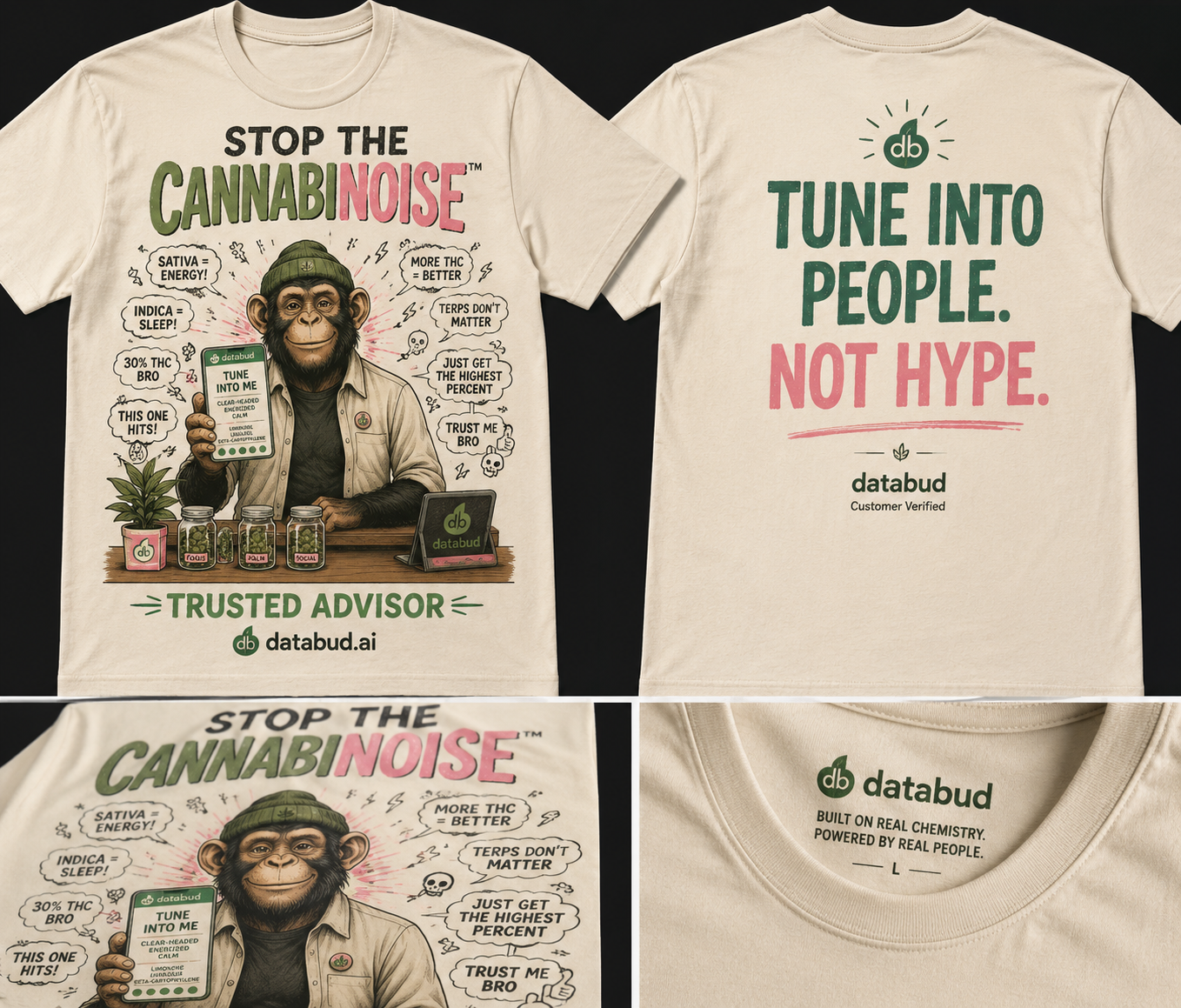
The Stop the CannabiNoise tee. Designed in the spirit of the music posters that called out the noise of their era. Limited run.

Stop the CannabiNoise t-shirt — front shows a chimp wearing DataBud headphones blocking out noise-word bubbles; back reads 'DataBud cuts through the noise. Science · Nature · Human. All singing the same song.'DM @data.bud for one

No checkout, no Shopify. Just a real conversation. Tell us your size + ZIP.

The platform built to cut through it

How DataBud Works

A consumer intelligence platform for cannabis. QR-based. Consumer-owned. No app required.

1
Step One
Scan

Every DataBud-enabled product has a QR code on the package. Point your phone at it. You see the verified batch chemistry — cannabinoids, terpenes, minor compounds — pulled straight from the lab certificate.

2
Step Two
Log

Three taps. Mind, Body, Mood. Under thirty seconds. No account required. The platform captures your experience against the chemistry that produced it.

3
Step Three
Learn

Over time, your DataBud Card emerges — a private profile of what actually works for your body. Show it to a budtender as a Trusted Advisor. Refer back next time you shop.

For the people on the front lines

The Trusted Advisor

One of the most under-supported roles in legal cannabis is the budtender. They're expected to be part chemist, part therapist, with limited tools and no recognition for the trust they build with customers. The industry calls them salespeople. We don't.

The Trusted Advisor program lets a consumer designate a budtender they trust. That budtender then gets anonymous access to the consumer's DataBud Card — what tends to work, what tends to cause issues, what to look for next time. The conversation shifts from “what are you looking for today?” to “based on what's worked for you, try this batch.”

Consumer-initiated. Consumer-controlled. Consumer-revocable. The budtender never sees a name — just the patterns.

Recognition for the people doing the work. No personal data shared. No producer access.

Live in Washington State

The First DataBud-Enabled Brand

The first cannabis brand putting DataBud-enabled QR codes on Washington shelves is Girlweed — a feminine cannabis lifestyle brand. Girlweed's Soft Glow Peach gummies are available in Washington dispensaries now. Every tin includes a scannable code that links directly to verified batch chemistry plus the DataBud logger.

Girlweed is the demonstration. The platform is the story. Additional brands across Washington — and additional states in 2026 — will follow.

What the platform produces

Your DataBud Card

The card is what emerges from the data — your private intelligence profile. Front: a snapshot of how you tune. Back: what works, what causes issues, what to look for. The card lives in your wallet. The data lives with you.

The DataBud Card · Evidence-based · Privacy-first · Consumer-owned

For media

Press

Full press kit, including narrative, fact sheet, founder bio, myth table, image assets, and citations.

Press Kit
Download the kit
Get the PDF →
Media Inquiries
Get in touch
press@databud.ai

For trade inquiries, partnership conversations, or Trusted Advisor onboarding for retailers, contact press@databud.ai. Response window: 24 hours for press on deadline.

Science
The cannabinoids and terpenes in that specific harvest.
Nature
Your body's chemistry — different from anyone else's.
Human
The day, the dose, the context, the setting.

All singingthe same song.

That's the only model that ever made sense. Now you have a way to listen.